We consume more paper every year
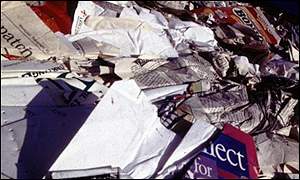
It is one of the paradoxes of the information age that the more we rely on digital devices the more paper we consume.
You might think as we call on more information stored on computer networks, and live our lives with the help of gadgets that merrily swap data, our reliance on paper would fade.
Instead, the exact opposite is happening.
In 1980, a year before the introduction of the IBM PC, world office paper consumption stood at 70 million tons. By 1997, the total had grown to almost 150 million tons. The upward trend has been maintained over the last few years.
Paper play
The reasons for this staggering increase have now been plumbed by Abigail Sellen from the Hewlett Packard labs in Bristol, UK, and Professor Richard Harper, head of the Digital World Research Centre at the University of Surrey.
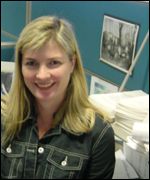
Abigail Sellen: Paper documenter
The pair asked why greater use of personal technologies like PCs, phones and handhelds had done little to diminish our appetite for paper.
They report their findings in a book The Myth Of The Paperless Office, published by The MIT Press.
Ironically, the idea of a paperless office emerged from the Xerox Palo Alto Research Centre in California, US, in the late 60s. At the time, Xerox made most of its money out of photocopiers that helped us consume ever more paper.
Readily to hand
The UK researchers conclude that the main reason paper remains popular is because technology has produced nothing that can match it in terms of usability and familiarity.
Paper notebooks are much easier to carry, use and show to others than their digital equivalents.
Also, existing technologies make it much easier to go from data to printout than the other way round. Scanners that can turn pages of notes into digital equivalents are expensive, cumbersome and time-consuming to use.
"If you are working on paper and then you need to take that information into the digital world, those technologies are not so readily to hand or so easy to use," said Ms Sellen.
Scribble pad
She said paper proved itself when people were doing "knowledge work" that involved reading lots of longer documents, summarising reports or planning strategies. Over half of all office work involves more than one document.
This knowledge work was much easier to do with paper copies that could be marked up and spread out on a desk than it was with digital documents, said Ms Sellen.
Some pieces of paper are more important than others
Paper is also very good when people need to swap and work on information during meetings. A common document people can scrawl on and annotate is much more use than a computerised equivalent.
This continuing dependence on paper meant that people with messy desks were doing important work, said Ms Sellen.
"If you want to know who's doing the real work look around, see whose desks are covered with paper and see who's wastebaskets are full," she said, "because those are the people doing the knowledge work, those are the people really getting down to thinking about information, constructing information, planning and that sort of thing."
Those with tidy desks are more likely to be carrying out routine tasks that can be completed quickly and leave little detritus. The researchers believe that because paper can do things that technology cannot, we will go on using lots of paper. There will be no dip in consumption.
Some technology firms are exploiting this continuing affection and looking at designing technologies with similar properties.
Abigail Sellen was interviewed by Tracey Logan of the BBC's Go Digital programme. More from this interview can be heard on the Go Digital radio show or by listening to the webcast.